Executive Summary Examples 2026: How to Compel Decision-Makers to Read On
A great executive summary is often worth more than the rest of the presentation combined: it decides whether a decision-maker will read any further. In this guide, we'll show you how to distill the essence of your message onto a single page that truly opens the door for your full presentation.
Love at First Sight
We’ve said it many times: business culture is in constant flux. The competition is fiercer, the number of professional players is growing, and the time allotted for decisions is shrinking. Leaders' attention is fragmented across multiple channels, decision windows are shorter, and the volume of pitch decks, corporate presentations, and business proposals is always increasing. In this sea of information, one element alone decides whether a document gets read or tossed aside at the start: the executive summary.
Many fall into the trap of thinking that decision-makers immerse themselves in the presentation and make a choice somewhere around the tenth slide. The reality is the decision is made in the first few seconds. That’s why the executive summary isn’t an introduction — it’s the most vital component of your presentation. In fact, it's often more decisive than the pitch deck itself.

A Genre of Its Own
At Pitch Experts, with over a decade of experience, we frame the executive summary as the presentation’s "one-minute quick test." If the summary features a clear structure, a concise message, and sharp visual focus points, the decision-maker will read on with interest. But if the executive summary is too long, logically flawed, or visually cluttered, the credibility of the entire document is compromised, and the decision-making process often never even begins. This is why you must treat the executive summary as a standalone genre with its own methodology, logic, and visual perspective.
What an Executive Summary Is (And Isn't)
Many still think of the executive summary as an introduction, a foreword, or a table of contents, but in practice, it serves a completely different function. The executive summary is essentially a mini-presentation before the main event. Its purpose is not to start a story but to summarize its most critical points. It doesn't prepare; it condenses and delivers. It doesn’t "set the mood", it cuts straight to the core to drive a decision.
One Minute, Five Points
The structure of an executive summary is easy to define: five core elements are always present. A brief and precise definition of the problem, a quick snapshot of the opportunity's scale, the operational logic of the solution, the evidence that validates the presentation, and a clear articulation of the next step or the offer. Together, these form the one-minute narrative that helps a leader decide whether it's worth diving into the details.
A modern executive summary is not just about content, it's about visuality. Decision-makers don't read linearly:
they first scan the headlines,
then the charts,
then the highlighted sentences.
Therefore, the structure, the visual focal points, and the information hierarchy are just as important as the text itself.
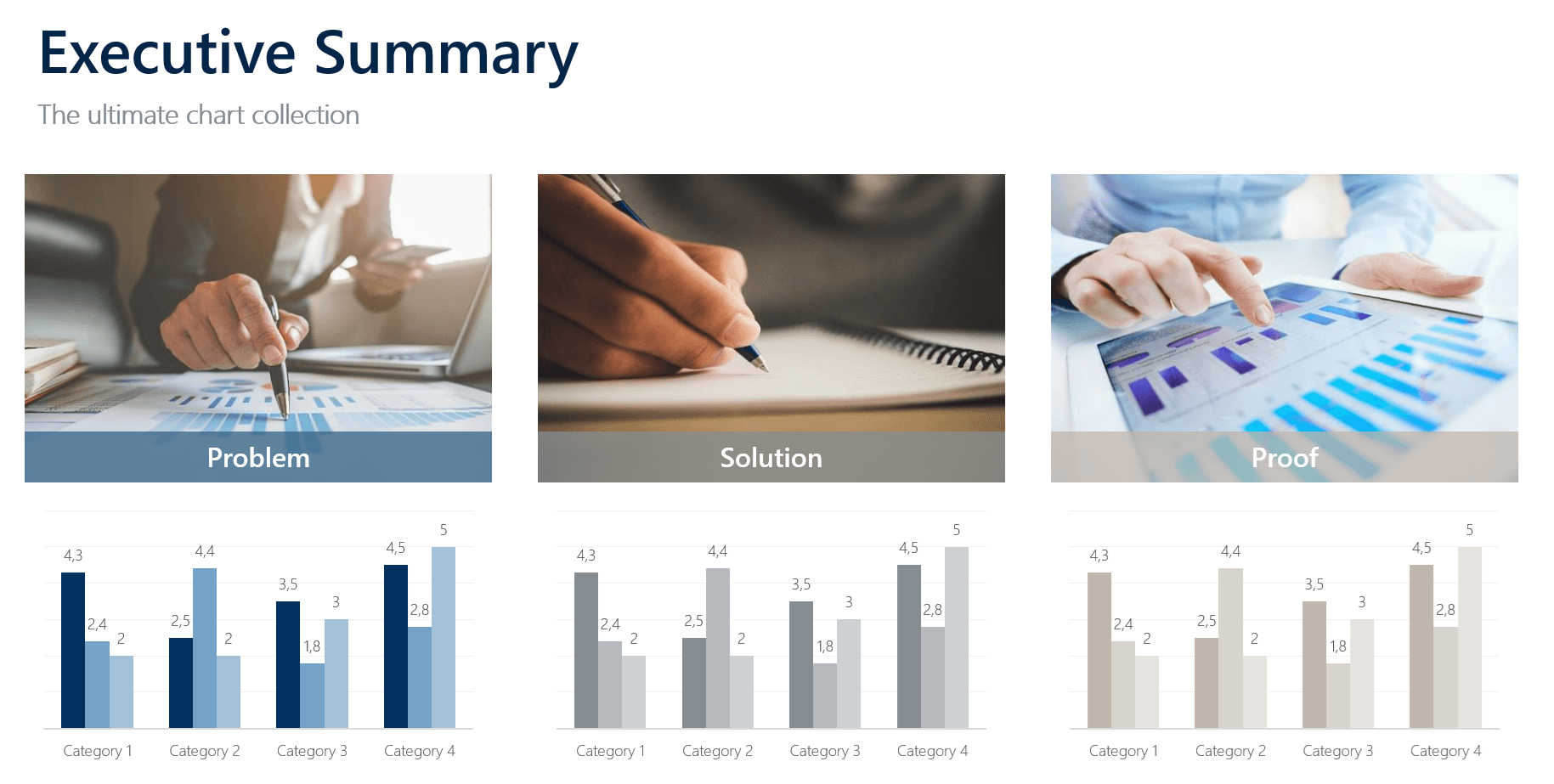
This slide breaks down the classic executive summary structure, distilling the problem, the solution's value proposition, and the proof into three sequential blocks. The strong visual focal points drive rapid scannability for decision-makers, while the charts below lend credibility to the business claims. It's ideal for demonstrating in under a minute why the topic is critical, how it can be solved, and what proves its effectiveness.
Click to download our ultimate chart collection!
Check out all other presentation templates!
👉 Financial Reporting Template
👉 HR Management Template
👉 OKR Template
👉 Communication Models Template
Our presentation templates aren't downloadable just yet due to some technical stuff, but we can send them over. Need a solution right away? Click here to get in touch!
Why an Executive Summary Works—or Fails
An executive summary's success is determined by a single factor: how easy it is to absorb. If a leader can grasp the story's logic in under a minute, they will read on, feeling that the material respects their competence and, of course, their time. However, if the summary is self-indulgent — long, overly detailed, or logically fragmented — it sends the message that its creators don't understand or can't articulate the essence of their own product, service, or even themselves.
A common mistake is overwriting the executive summary — often to project credibility — turning it into an essay rather than a decision-support tool. Another frequent error is a broken logical flow: the problem isn't clarified, the solution isn't positioned, and the benefits aren't connected to the business goal. In many documents, data appears without explanation, as if it speaks for itself. But for a decision-maker, numbers are only valuable and interesting if they understand how they fit into the story. From a visual standpoint, common mistakes include over-designed charts, excessive use of icons, insufficient whitespace, or simply a poorly organized structure.
The Pitch Experts 5-Element Executive Summary Structure
Pitch Experts uses a structure that is simultaneously narrative, logical, and visual. The system’s goal is to allow the decision-maker to grasp the main point with the least amount of effort.
The first element is framing the problem and context in a single sentence. This sentence anchors the topic's relevance and clarifies what the decision-maker stands to lose or gain by engaging with it.
The second element is presenting the opportunity, where two key data points or trends are enough to convey the scale of the market, need, or change. This is where visual elements like a "growth chart" or a simple date-based timeline, found in The Ultimate Chart Collection template, can be introduced.
The third element is demonstrating the solution's operational logic. Here, we often use a 3-step flowchart — built on the visual logic from the Process flow charts template — to show how it works. The three components of operational logic — input, processing, output — are featured in every executive summary because they reveal how the solution functions and why it's effective at a single glance.
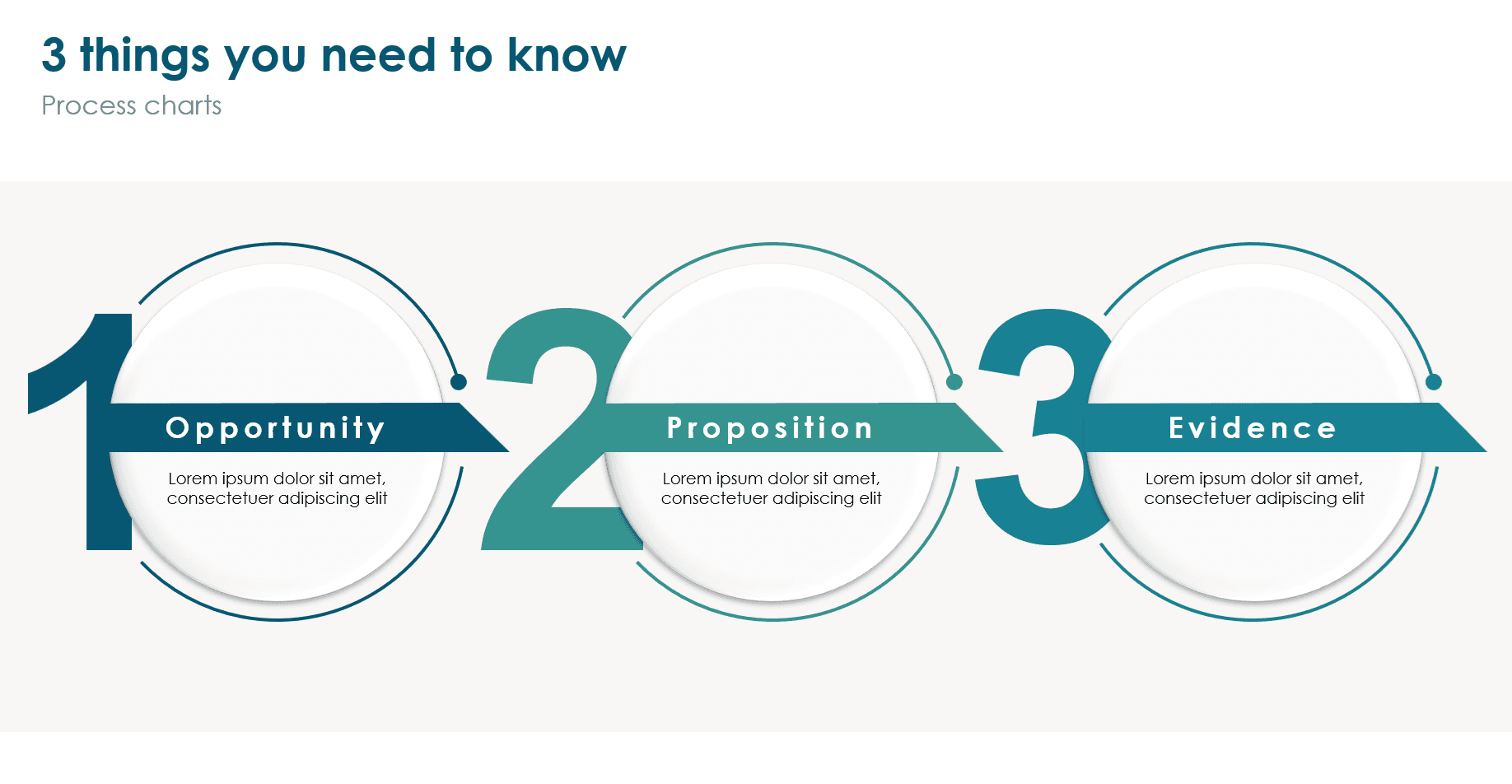
This version builds the executive summary along a narrative arc. The 1→2→3 step logic visually guides the eye from the opportunity, through the proposal, to the proof. The circular shapes and numbers create a strong visual rhythm, which is highly effective for focusing leadership attention in a short amount of time. The slide is both clean and modern, making it particularly effective in workshops, at the beginning of pitch decks, and in strategic proposals.
The fourth element is the proof: a summary of traction, partnerships, results, or pilot outcomes. Timeline-style slides, included in our Chart Collection, are excellent for this. The proof should be no more than three short statements, as credibility, not detail, is what matters here.
The fifth element is defining the next step or the ask. This could be a call for a meeting, a demo, sending further documents, or a specific decision point. The key is for the decision-maker to see exactly what happens if they move forward.
How the Executive Summary Fits into the Presentation
The executive summary can play several roles. It can be the "slide zero" of a pitch deck, positioning the presentation even before the title page. It can be a standalone, one-page PDF — a "one-pager" — sent to decision-makers via email. And it can be a mini-presentation in itself, for when a leader receives it without the time or opportunity to review the full deck.
In a presentation context, the visual language of the executive summary is far more critical than in text-based documents. Here, the eye guides comprehension. That's why it's best to use simple blocks, icons, clean flowcharts, and plenty of whitespace. The executive summary must follow a minimalist, structured, and focused visual logic, consistent with the CI used in the company's other presentations.
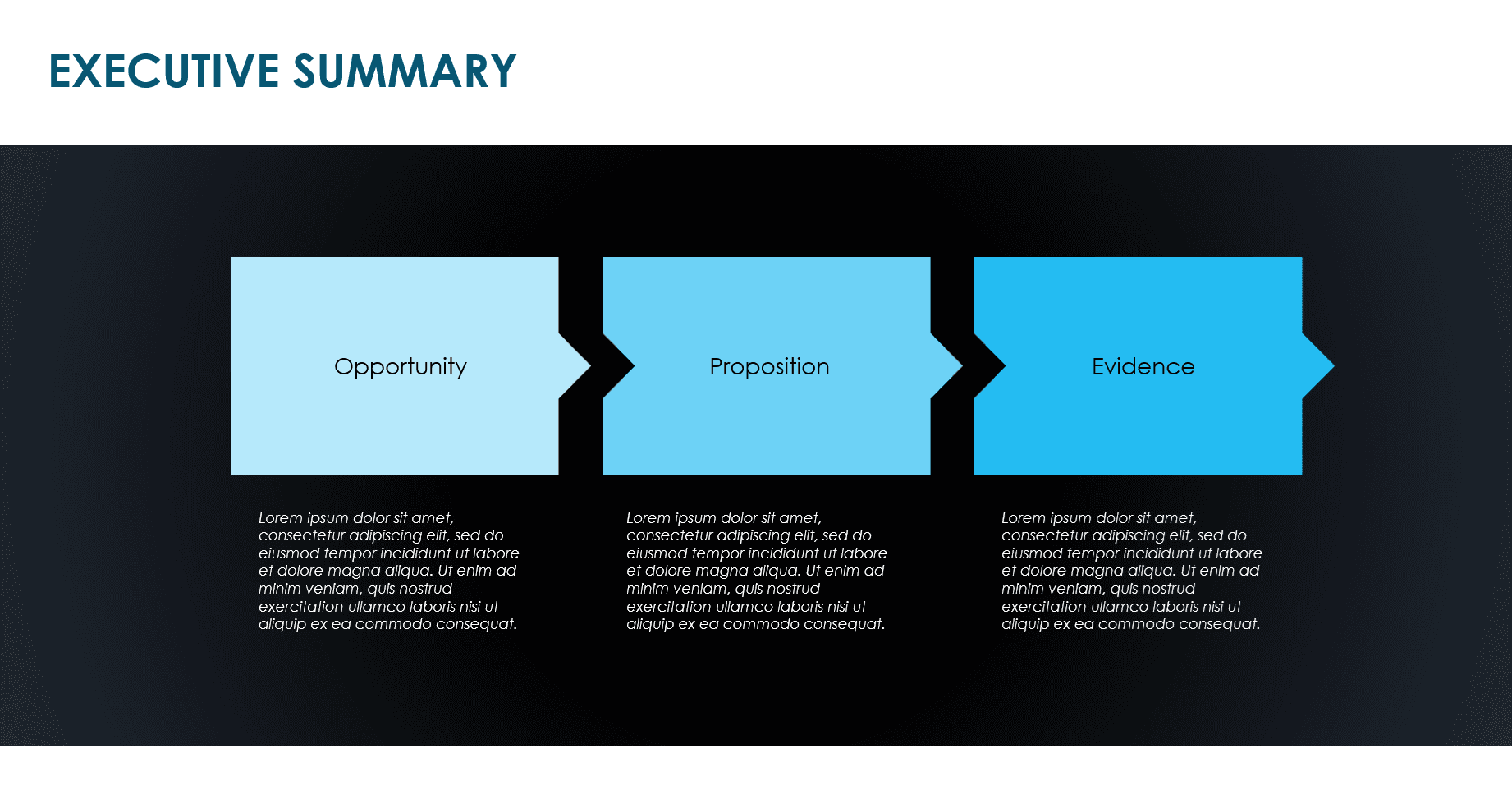
This slide presents a more dynamic, directed version of the executive summary. The arrow-shaped panels communicate progress, momentum, and a coherent logic. The title clearly anchors the slide's purpose, while the text bars below provide space to spotlight the core message. The design is particularly effective in executive and investor presentations, where the business weight and professional delivery of the information are under scrutiny.
What Visual Elements Work in an Executive Summary?
Pitch Experts presentation templates are perfectly suited for executive summaries, even without a dedicated summary template. A flowchart is ideal for showing the solution's logic. A three-block module is great for summarizing the value proposition or key benefits. A timeline is perfect for presenting traction or next steps. A growth chart excels at illustrating the scale of the opportunity. And an icon grid neatly summarizes benefits, features, or results. These are all visual elements that regularly appear in Pitch Experts presentation templates, which is precisely why they work so well in an executive summary.
Crafting a Decision-Maker-Focused Executive Summary in 2026
The modern executive summary is the art of compression. But brevity alone holds no value: a "dense message" only works if the structure is clear. Visual logic isn't decoration, it's a system that aids comprehension. The story is a business narrative, not an anecdote. The numbers are arguments, not ornaments. And the summary is a catalyst for decision, not a preface.
When Should You Bring in an Agency?
When an executive summary carries significant business stakes — such as in an investor round, an corporate presentation, a pitch, a board meeting, or an M&A process — a professional template, a well-crafted story, and a strong visual structure provide a competitive edge. As a professional pitch deck design agency, Pitch Experts offers services like custom template creation tailored to your corporate identity, complete pitch deck structuring, and presentation training that helps leaders communicate with a decision-maker mindset.
Tell me more about presentation agency services!
Let's start a conversation.
We're happy to answer any and all of your questions.
Summary
The executive summary is the most important element of your presentation. It can determine in under a minute whether a decision-maker will engage with your material or move on. It demands a different logic, a different visual approach, and a different narrative discipline than the rest of the presentation. By consistently applying this structure, you're not just creating a good summary, you're forging a strategic tool that has a real impact on decision-making. The Pitch Experts methodology provides a guide for this, building on narrative, logic, and visual focus — because that's how decision-makers think.