Product Presentation 2026: Crafting a Cognitive Interface for Your Audience
We have reached an era where a poorly crafted slide can cause more damage than a bug in the code. Within marketing, the product presentation has become the most rapidly evolving format—not because it's constantly getting prettier, but because it's getting smarter. The purpose of a great pitch is no longer a narrow product demonstration, it is to summarize and contextualize the very problem it solves.
The Evolution of the Product Presentation: From PDF to Decision-Support System
For a long time, the product demonstration was the most tedious genre in marketing. The "product deck" meant one thing: a document filled with feature lists, screenshots, bullet points, and the drone of a monotonous voice in a conference room. Around 2005, a presentation was little more than a static, unadorned PDF that explained what a product did. This was the Documentation Era. Information was transferred, and the diligent buyer was left to make a decision alone.
The Showmanship Era
For the next generation, the Apple syndrome became the defining influence. After 2010, Keynote presentations created a culture of their own, and the pitch became a form of show business. The product was no longer a list of functions but a star guest. The cultural, intellectual, and emotional arc introduced by Steve Jobs turned product launches into near-spiritual events. This focus on experience became embedded in the startup world's DNA. We learned that people don't remember data points, they remember the emotional reaction a story evoked. Visual solutions, minimalist slides, and high-contrast focal points all suggested that a product wasn't an object, but a process, a dynamic — a drama.
The Reign of Storytelling
The third era arrived between 2015 and 2020, when every deck became a storytelling exercise. Narrative was no longer just a rhetorical device, it became currency, a value in itself. Pitches were structured like movies, with characters, turning points, and tension. At the dawn of the storytelling era, the product's story became more important than the product's logic. This period was captivating, but it had its downsides: many corporate presentations became more like short films than decision-support platforms.
The "Ten-Minute" Reality
After 2020, we entered yet another new era. Decision-makers now live on a "LinkedIn schedule." The flood of meetings, the rise of remote and hybrid work, information overload, the attention economy, and decision fatigue have radically changed the demands placed on the product presentation. Suddenly, the crucial question wasn't how to make a deck sexy, but how it could drive a decision in under ten minutes. The pace of business accelerated while attention spans shrank. This created the fourth and current era of the product presentation, where the pitch functions as a kind of cognitive interface.
This new era is characterized by presentations that don't focus on showcasing the product, but on creating a thinking space for the decision-maker. A great pitch doesn't talk about features, it talks about what it activates in the client's mind. The Pitch Experts methodology is built on this exact principle: we build a thinking framework supported by visual structures that follow the mental behavior and decision-making mechanisms of leaders. We will discuss this logical shift in more detail, but if you are specifically interested in practical advice, read our article on the structure of a modern product presentation.
The Product Presentation as a Thinking Space
A presentation is not a file. A presentation is an interface to the buyer's brain. This statement may seem provocative at first, but based on observations from cognitive science, it is a completely defensible and logical proposition. Humans process the world not as a series of images, but as patterns. Therefore, the task of a product presentation is not to show what the product is, but to show how to think about the problem the product solves.
When a presentation provides structure, it is actually building a mental model. As the audience listens to or reads the presentation, they are not processing a linear narrative but building an associative network in their minds. A great pitch consciously "weaves" this network: it highlights the context, finds the focus, identifies the decision point, presents evidence, and forecasts the outcome. From this perspective, the essence of a product is not its features, but the new logic it introduces to the market.
These insights have naturally had a strong impact on the dramaturgy of the pitch. The classic structure—problem, solution, features—is no longer sufficient. The new dramaturgy has given birth to the following sequence: Context, Tension, Logical Shift, Proof, and Outcome. Paradoxically, the product presentation no longer presents the product up close. Instead, the pitch reveals the world in which the product's birth, existence, and operation have become inevitable. Pitch Experts has built over a hundred corporate-branded product presentations in recent years. The examples on our Use Case page demonstrate this: today, a product presentation is the act of defining a product's strategic dimensions.

Discover our Use Cases to see examples of custom presentation templates by Pitch Experts.
The Product Presentation as User Experience
Today, a product demonstration is, in fact, a user experience. Not UI, not just design, but a tool for rapid comprehension. When someone watches a pitch, they are connecting with and following a thought process. We call this presentation user experience. The pitch itself is the journey: how a person gets from the problem to the inevitability of the solution. The slide-flow actually follows the audience's mental path: how they perceive the context, when they understand and feel the tension, when the shift occurs, and when they reach the evidence threshold where facts, not design, do the talking.
A product demo or live demo is just one point on this journey. The final decision is determined by the pattern that forms in the audience's mind based on the information presented. There is a direct correlation between the quality of the audience's experience and the speed of their understanding. This is presentation intelligence, where logic, not design, plays the leading role.
The downloadable presentation templates from Pitch Experts follow this exact modeling logic. The Ultimate Chart Collection, for example, is not a simple collection of slides, it is a set of decision patterns. Behind every slide is a thinking model: a three-column concept, a cascading solution logic, a cause-and-effect diagram, a flowchart, a proof block, or a strategic framework. The purpose of the template is not to create a "beautiful" presentation, but to make the product's logic tangible.
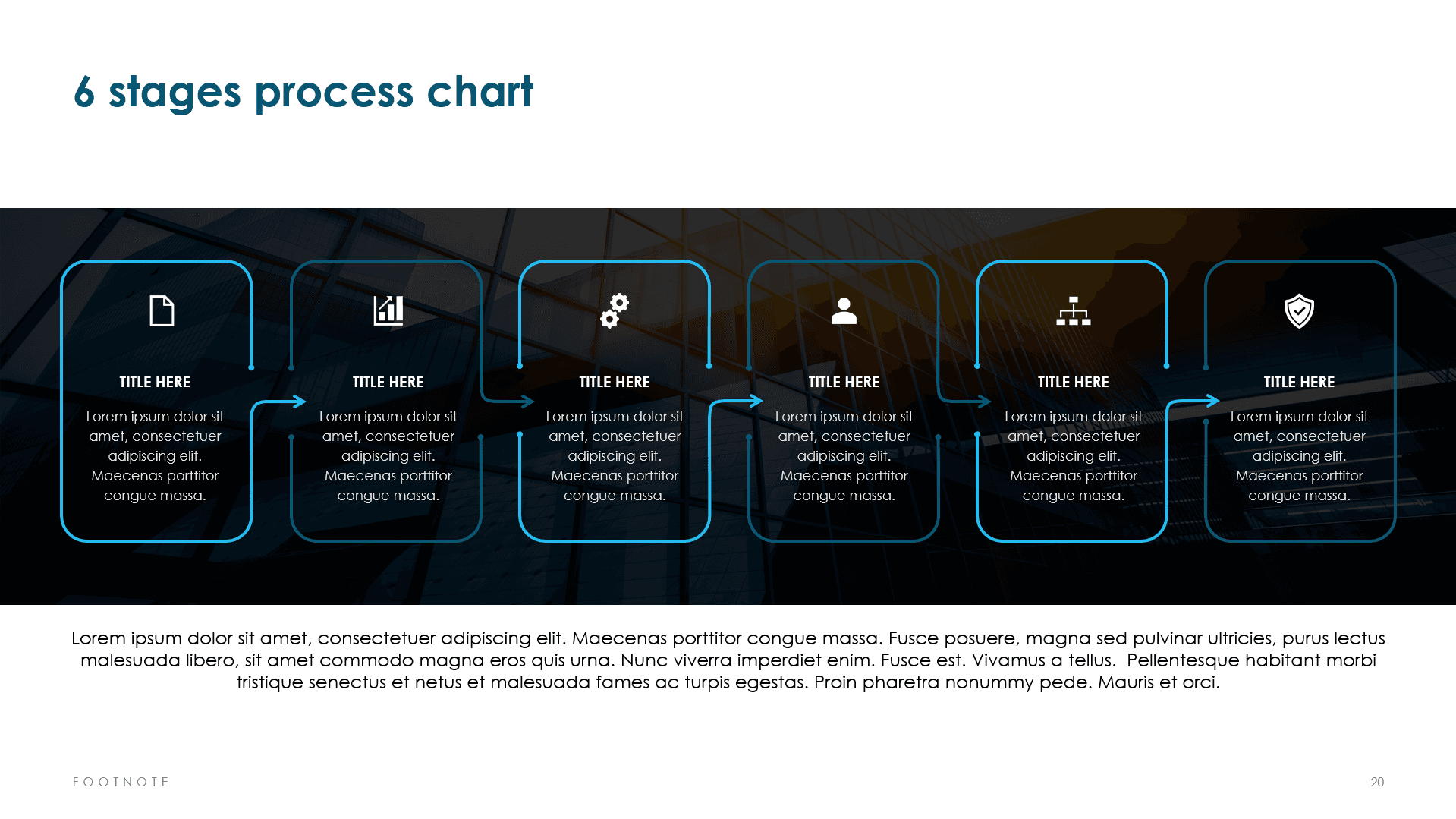
The Process Flow Chart template operates in the same way. The diagrams represent the logic of the marketplace: how the problem is structured, where the tension lies, what decision points exist, and where the solution becomes inescapable. A great product presentation does not strive to make features interesting, it strives to make choosing the product inevitable.
I need a custom presentation template aligned with my corporate identity.
I need help fast and I'm looking for a downloadable presentation template.
Why Isn't More Storytelling Enough?
The market has become immune to narrative. There are too many well-written stories, too many dramatized pitches. Most decision-makers have seen a hundred well-crafted presentations and know exactly when narrative manipulation begins. Therefore, the modern product presentation is more than just a story. The story is merely the frame, not the substance of the persuasion.
The true power of a product demonstration lies in its proof. The business proof and the product proof together provide the weight of the argument: traction, unit economics, distribution logic, customer examples, performance, scalability. Today's pitch doesn't say, "Here is our product, this is what it does." It says, "This is the logic of the world in which our product is the necessary solution."
This is why the Pitch Experts methodology builds a proof stack. The slides don't just provide a visual experience, they build layers of evidence: first, they prove the truth of the context, then the inevitability of the solution. This is the new language of business presentations: the pitch is, in fact, an abbreviated whitepaper, organized into a visual structure.
AI and the Future of the Product Presentation
In the coming years, most presentations will likely be created by AI. It designs faster, produces faster, never gets tired, and has an inexhaustible visual database. When this happens, slide design will inevitably become a standardized commodity. The decisive factor will no longer be who creates the more beautiful slide, but who thinks better about the product. This will bring a decisive change to the market. We must accept the idea that a presentation's value will not come from its aesthetics, but from its architecture. The thinking, the logical model, the decision points, the arc of proof—these will almost certainly remain human tasks.

Pitch Experts can be your partner in this change: we don't just sell visual solutions, we sell thinking models. The future product presentation will be like programming, built on logic. A poorly crafted slide will cost more than a bug in the code because a bad slide doesn't just create a faulty function, it triggers faulty thinking.
Contact us to future-proof your communication strategy.
The Product Presentation as a Corporate Snapshot
A product presentation is the essential extract of a company's thinking. A great one condenses the company's technology, strategy, business model, market context, and cultural messages. This is why the presentation has become a strategic tool. The Pitch Experts Use Case examples clearly show how diversely this thinking can manifest. Custom-branded templates provide not just visual unity, but cultural identity: the pitch itself becomes the brand.
Why Is Training Necessary Alongside the Product Presentation?
To reiterate, the documentation era of presentations is long gone. Today, a product presentation is pure interaction. Therefore, a great presentation template is not a guarantee of success. Your team must learn how to deliver the product—that is, the thinking model. The presentation training programs from Pitch Experts deliver exactly this knowledge. Participants don't just learn how to create beautiful slides quickly and confidently, they also learn how to structure their thinking for decision-makers.
I want to learn more about the presentation training from Pitch Experts.
Summary: The Pitch is the Language of Thought
Today, the product presentation is the purest form of corporate thinking. The pitch does not highlight the product, it contextualizes it. A great product presentation doesn't talk about features, it talks about what problem it solves in the world and why its existence is necessary.
The modern product presentation is more powerful because it is more intelligent. It doesn't just inform, it makes you think. It doesn't just transfer information, it creates a pattern. This is why the product demonstration has become the fastest-growing format in marketing. The design is just the surface. The essence—the depth and logic of the product—is determined by the structure.
Pitch Experts provides its clients with modern, instantly downloadable templates, a proven methodology, and a new way of thinking. Our downloadable templates provide logic, our custom-branded solutions strengthen your company's visual culture, and our presentation training builds creative competence.
I'm looking for a downloadable presentation template.
I need presenatation agency services for a custom presentation.
I'm interested in presentation training.
Content recommendation:
👉 How to Create a Sales Pitch?
👉 How to Build a Modern Business Playbook